
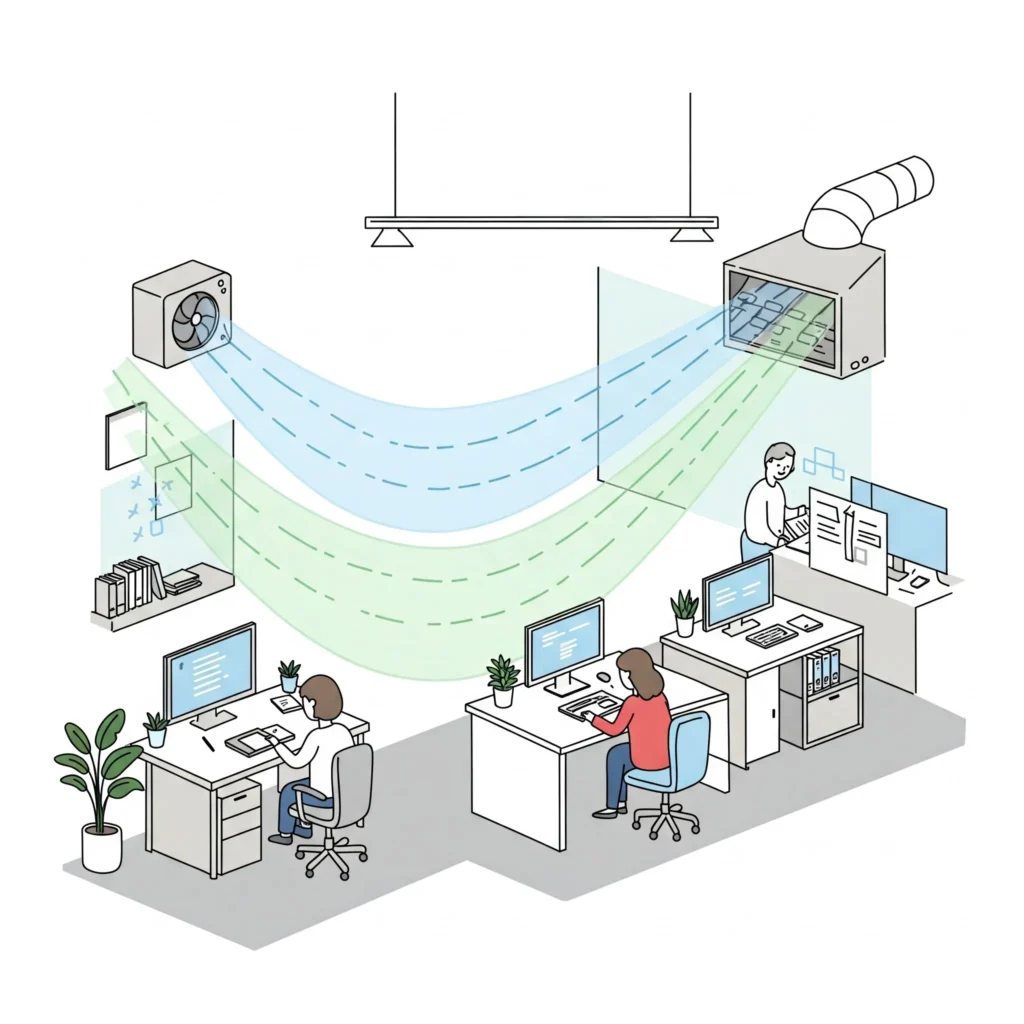
At Urecsys, we help optimize your building’s HVAC (heating, ventilation, and air conditioning) system to ensure healthier indoor air and greater energy efficiency — all in real time. Before applying advanced AI and dynamic control, it’s important to understand the classic foundation of indoor air quality analysis: the mass balance approach.
What is Indoor Air Quality?
Indoor Air Quality (IAQ) refers to the cleanliness, safety, and freshness of the air people breathe inside buildings. It’s influenced by:
- Pollutants generated indoors (released from materials like wall and furniture paint, flooring, and other construction materials, including VOCs and formaldehyde)
- Pollutants entering from outside, including NO₂, CO₂, O₃, PM, etc. (produced by urban traffic, industrial activities, and environmental events like desert dust storms)
- The rate of ventilation and filtration
- Air mixing and effectiveness of airflow
The Classic Approach: Mass Balance
The mass balance equation is a standard method used to estimate the concentration of a pollutant in the breathing zone indoors. It compares the total amount of contaminants entering a space with the system’s ability to remove or filter them.
The Equation:
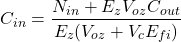
Where:
 – Indoor pollutant concentration
 – Indoor pollutant generation rate (for example, from people, furniture, or equipment)
 – Outdoor pollutant concentration
 – Outdoor airflow rate, representing the volume of outdoor air brought into the building through the ventilation system to dilute or replace indoor air (cfm)
 – Airflow through the cleaner or filter, which is the amount of air being cleaned by the air filters (cfm) (most of the above pollutants need expensive active filters)
 – Ventilation effectiveness, which measures how well the supplied air is mixed and delivered to the breathing zone
 – Filter effectiveness, which measures how well the air cleaner or filter removes the pollutant
The numerator represents the total amount of pollution entering the indoor air, including both indoor-generated and outdoor pollutants, while the denominator reflects the system’s ability to reduce or dilute these pollutants through ventilation and filtration. Therefore, the equation estimates the final pollutant concentration in the building’s air.
Urecsys: Real-Time IAQ Optimization
While the mass balance approach provides a solid foundation for understanding indoor air quality, real-world conditions — including pollutant levels, occupancy, and outdoor climate — vary constantly over time and across different regions or buildings.
That’s why at Urecsys we go beyond static calculations, using real-time data and intelligent control to adapt dynamically to changing environments:
- Continuous monitoring of outdoor air pollution and climate conditions
- AI-powered prediction of key indoor pollutants such as O₃, PM 2.5, and NO₂
- Intelligent control of ventilation and filtration systems based on real-time data, aligned with ASHRAE standards for optimal IAQ and compliance
- Adaptive response to pollution levels and environmental conditions
- Strategies to save energy and reduce AHU operation
In our upcoming blog posts, we’ll explore the transition from traditional physics-based models to big data time-series analysis, and how machine learning techniques can enhance indoor air quality assessments — stay tuned!