
In recent years, energy has become a prominent factor across many market sectors worldwide. This trend has led to increased regulation, as well as growing awareness around energy consumption. The building maintenance and management industry is no exception. Optimizing and managing the energy consumption of non-residential buildings, or entire portfolios, is now a central priority for building owners.
When analyzing the energy consumption of a typical non-residential building, there is significant variation depending on system design, use case, and local climate. Despite this variability, one fact remains consistent: HVAC systems account for a substantial portion of total energy consumption.
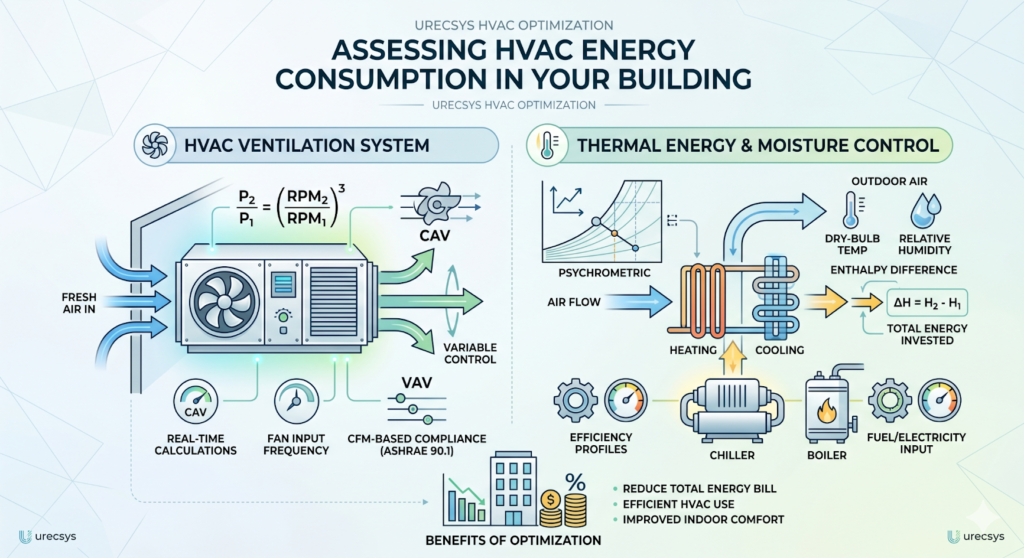
As part of the Urecsys HVAC optimization process, we combine engineering models and data-driven methods to estimate and predict a building’s energy consumption in real time. This enables more efficient HVAC operation and supports meaningful reductions in overall energy costs. When analyzing common HVAC systems, we typically divide consumption into two main components: ventilation and climate control.
______________________________________________________________________________
The HVAC Ventilation System
To maintain healthy indoor environments and prevent the buildup of stale air, HVAC systems introduce a controlled volume of fresh air into the building. In large non-residential buildings, this process is typically handled by Air Handling Units (AHUs), which rely on powerful fans to move air throughout the system. The energy required for this process is defined as ventilation energy.
A supply fan is usually rated with a nameplate energy value. In Constant Air Volume (CAV) systems, this value can provide a rough estimate of energy consumption over time. However, these ratings are often determined under standard laboratory conditions and tend to overestimate real-world performance. By using measured operational data alongside established standards such as ASHRAE 90.1, this estimate can be refined to better reflect actual conditions.
In Variable Air Volume (VAV) systems, energy consumption is more dynamic and depends on system operating conditions.
A basic estimate can be derived using fan laws (affinity laws), which describe the relationship between airflow, pressure, and power.

However, real-world factors such as system friction and static pressure introduce additional complexity. Incorporating equipment-specific performance characteristics or standardized part-load curves allows for more accurate estimation under real operating conditions.
______________________________________________________________________________
Thermal Energy and Moisture Control
Thermal energy typically represents the largest share of HVAC energy consumption. As outdoor air is introduced into the building, it must be conditioned to maintain indoor comfort and appropriate humidity levels. Proper humidity control is also essential to prevent mold growth and maintain a healthy indoor environment.
The study of air and its thermodynamic properties, known as psychrometrics, provides the foundation for understanding this process. By identifying two independent properties of moist air, all other properties can be determined. This relationship creates a 2D map for any given air state, which is easily visualized using a psychrometric chart.
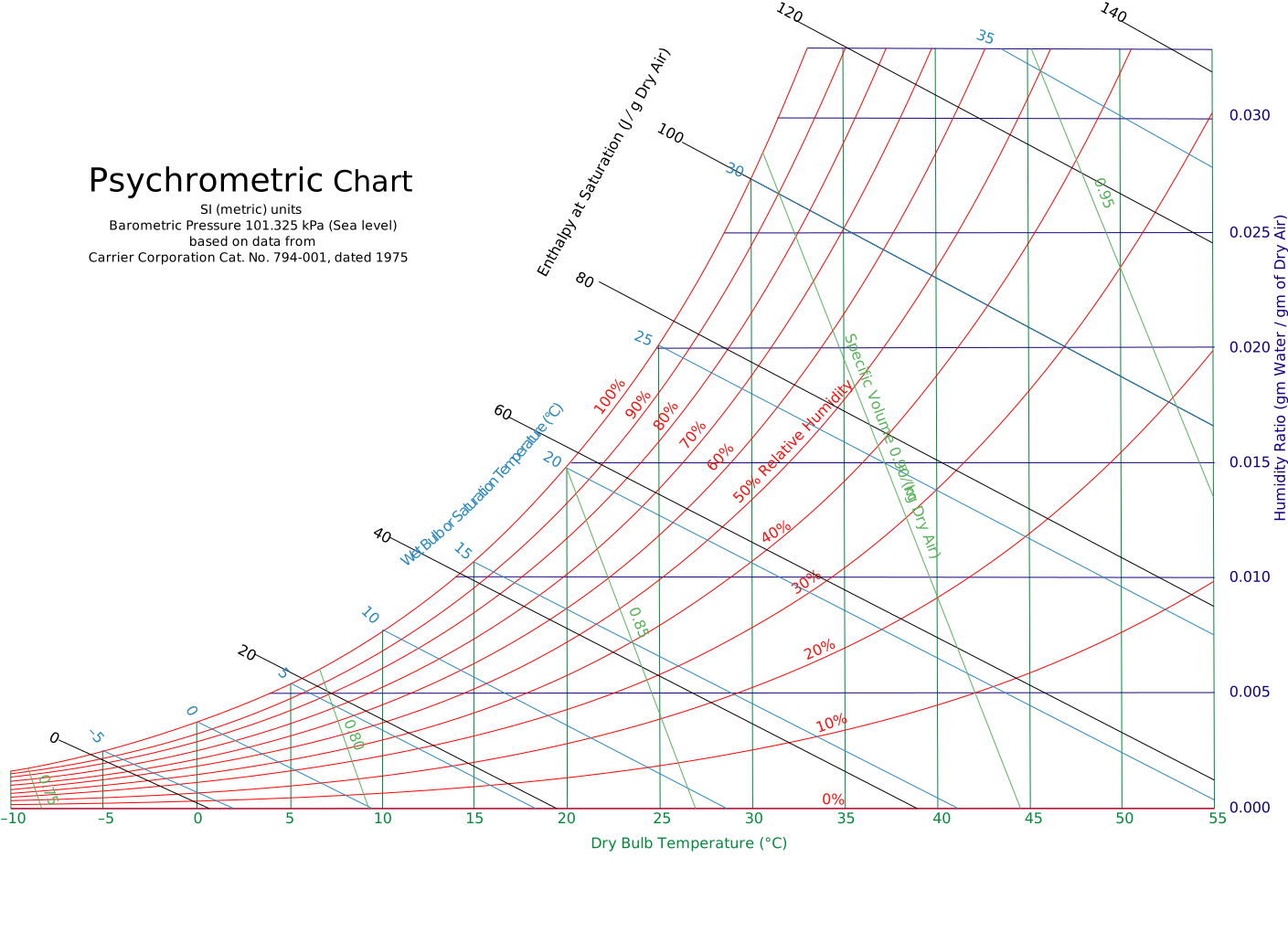
Dry-Bulb Temperature represents the standard ambient air temperature, while Relative Humidity indicates the amount of moisture in the air relative to saturation at a given temperature. Using these values, we can derive enthalpy, which represents the total energy content of the air
(expressed as H=E+PV ).
By calculating the difference between the enthalpy of incoming outdoor air and the conditioned air supplied indoors, we can estimate the total energy required for heating, cooling, and dehumidification.
This conditioning process typically occurs within the AHU through heat exchangers, with energy supplied by central systems such as chillers or boilers. The efficiency of these systems varies based on operating conditions, including ambient temperature and load levels. By accounting for these variables, we can derive a reliable estimate of total HVAC energy consumption.
______________________________________________________________________________
From Estimation to Optimization
By combining these engineering principles with real-world operational data, it becomes possible to build a clear and accurate picture of HVAC energy consumption.
This level of visibility is what enables Urecsys to go beyond monitoring and actively optimize system performance in real time. By continuously adjusting system inputs based on changing environmental conditions, occupancy patterns, and energy dynamics, building operators can reduce energy costs while maintaining air quality, comfort, and regulatory compliance.